

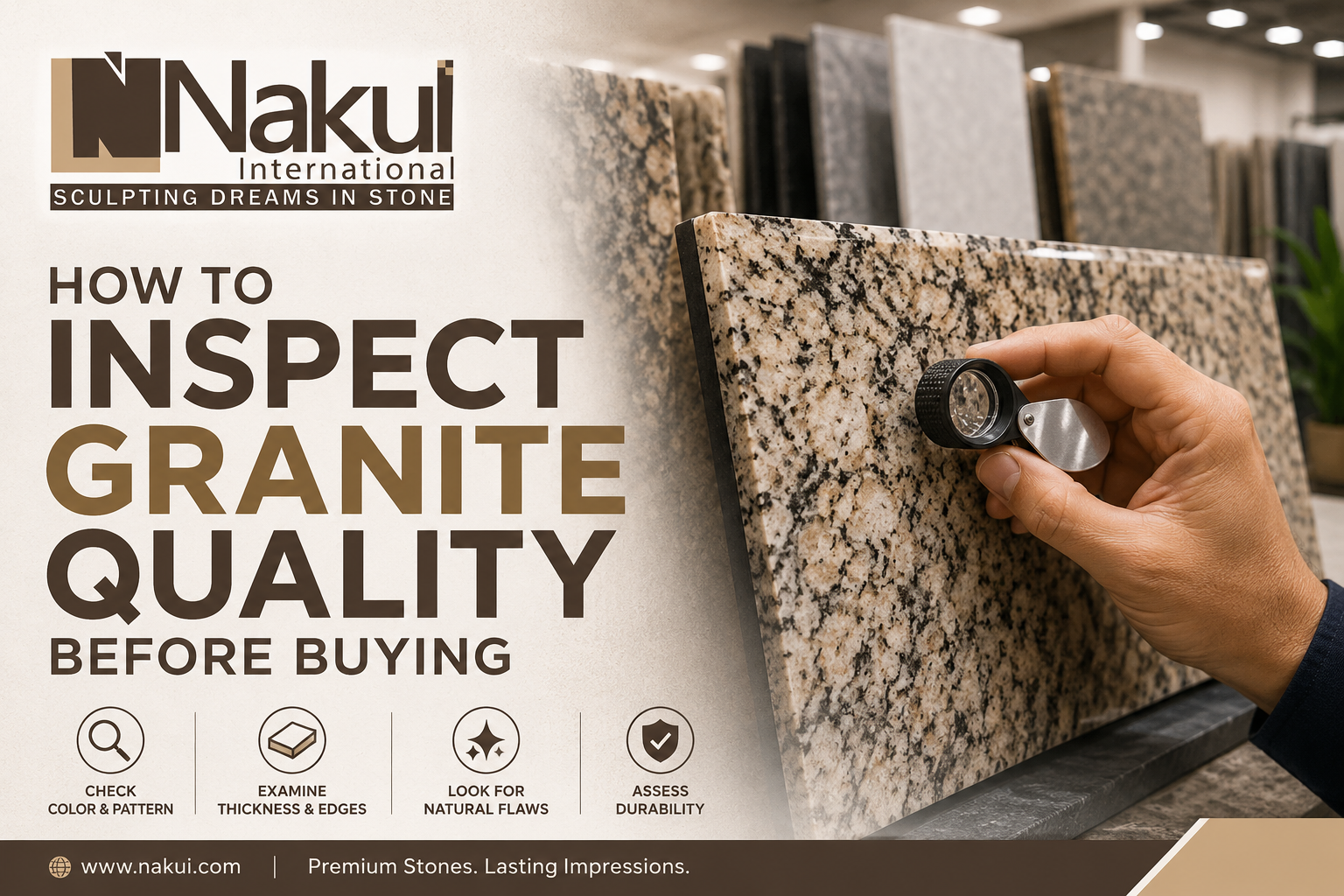
More than just a stone, granite is a lifelong investment that is popular for its strength, beauty, and value in any space. From sophisticated countertops in the kitchen to stylish flooring and the interiors of a commercial building, the quality of the granite influences durability, aesthetic appeal, and performance directly. Yet, most buyers often focus on nothing more than color and design, leaving out the most crucial aspect – quality inspection.
Two granite slabs can appear visually very similar to the naked eye; however, on closer inspection, the variation between the slabs could be enormous in terms of strength, polish, thickness, finish, and longevity. The hidden flaws-a crack, uneven surface, excess porosity, or bad finish-will cost you a fortune in repairs and give you sleepless nights in the future. That’s the very reason why knowing how to inspect the quality of granite before making a purchase is extremely important for homeowners, architects, builders, and interior designers alike.
Nakul International believes that there can be no compromises with the quality of granite provided and abides by stringent quality checks. Identifying the quality of granite can be done effectively and reliably using inspection checks and technical know-how.
Why Granite Quality Inspection Is Important?
Structural Integrity: Checks for structural flaws (hidden cracks, excessive resin filling) that will ultimately deteriorate the stone and affect its longevity.
Dimensional Tolerances: Assesses the thickness of each slab and the finish on the edges, to ensure adherence to required construction specifications as a result of the likelihood of thinner, non-uniform slabs breaking under pressure.
Porosity/Stain Resistance: Evaluates rates of water absorption, which will protect against moisture deterioration as well as stains, providing a hygienic surface where needed.
Uniformity: Checks for any disparities in color and pattern, in order to install consistent tile or closely color-matched slabs side-by-side.
Key Factors to Inspect Before Buying Granite
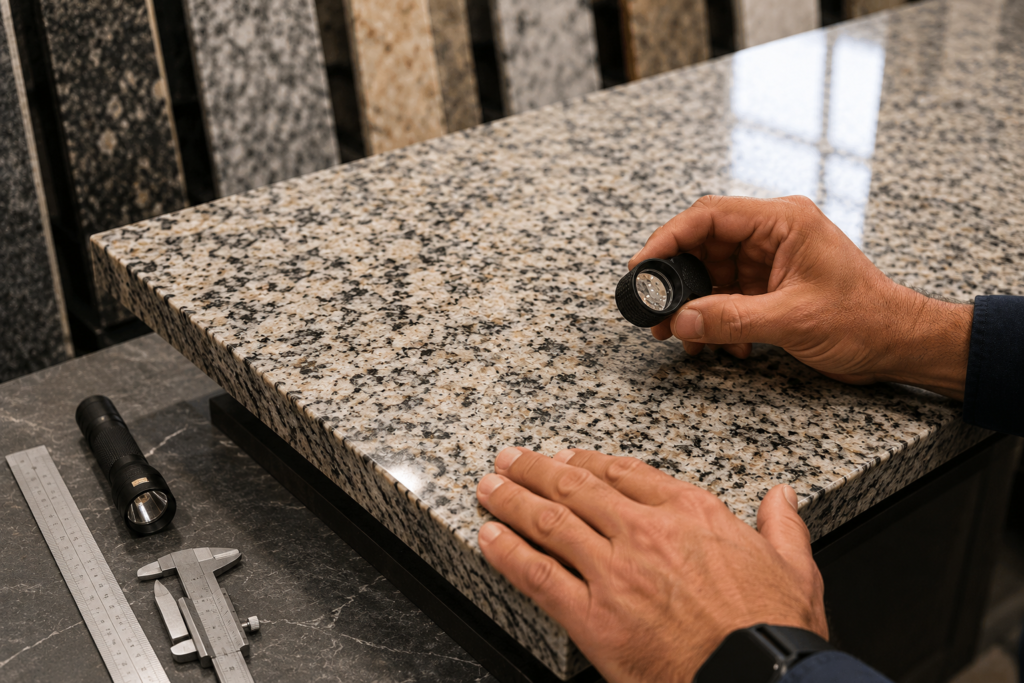
It’s true that granite has multiple colors and patterns to offer for a new purchase; however, there’s much more to it than just color and patterns alone. A high-quality granite must be strong, durable, smooth, well-finished, and must perform well for a longer span of time. A thorough check before buying the granite saves you from installing cracks, stains, uneven surfaces, and below-standard granite in your residential and commercial spaces.
Here are some key factors you must check before buying granite:
Check the Surface Finish
Surface finishing is one of the main tests that gives an indication of the granite’s quality. Premium granite should possess a consistent, polished, and smooth surface, which is neither dull nor rough.
Check for Fissures and Cracks
Inspect the granite under good light to rule out deep cracks, breaks, or chip-offs to understand its integrity, even though granite will always maintain its structural integrity.
Check Granite Thickness
The strength and endurance of the granite slab depend on the thickness, which is uniform throughout. Unevenness in the thickness might create a problem in its installation and may diminish its quality and performance.
Test the Water Absorption Limit
Highly quality granite has very low porosity, which means the absorption limit of water is minimal. To determine this, simply pour a drop of water on the stone; the granite may turn out to have absorption problems if water seeps into the stone readily, creating dark patches on the surface, and that can lead to stain formation on your stone with more ease.
Examine the Color consistency of the Granite
There is variation in the natural patterns on every piece of granite, but if the granite pieces show too much variation, then it could affect the final appearance of the slab or wall, floor, etc., when installed for residential or commercial purpose for example, when installing a large floor, check consistency to bring out uniformity and grace.
Understanding Different Grades of Granite
The granite comes in 3 different types, these types are:
Grade 1: Entry-Level Granite
The entry-level granite may be pre-fabricated and known as “builder” or “commercial” grade. This granite is used for furniture or apartments. It requires support of plywood to avoid breakage because it has a thinner slab. It comes in a variety of colours and patterns.
Grade 2: Middle-Grade Granite
It is an affordable, mid-range stone and has an average thickness of ¾-inch. It also contains some imperfections, like inconsistent colour gradients or patterns. It is tougher and durable than level 1 granite.
Grade 3: High-Grade Granite
The highest grade is the most expensive and very rare in appearance, colours, and patterns. It is perfect for applications that require both aesthetics and functionality, such as luxury residences and premium hotels.
Why Choose Nakul International for Premium Granite?
When it comes to selecting granite for residential, commercial, or export projects, the most important thing is quality, reliability, and expertise. We have built a strong reputation in the granite industry by delivering superior quality combining durability, elegance, and precision craftsmanship. Here’s why customers across the globe trust us for premium granite solutions.
Superior Quality
Quality is very important in the granite industry and every granite slab undergoes strict inspection procedures to ensure utmost quality. We source granite from trusted quarries and use advanced processing technology to maintain consistent texture.
Advanced Manufacturing and Processing
We use modern cutting, polishing, and finishing machinery to deliver good-quality granite products. This gives customers confidence that the granite they are choosing is suitable for both luxury and large-scale projects.
Competitive Pricing
We offer competitive pricing to our consumers while maintaining high standards in sourcing, processing, and packaging. Customers get excellent value for money, especially for bulk orders and export requirements.
Experienced Team and Customer Support
We are backed by a knowledgeable and experienced team that guides customers throughout the selection and buying process. From helping clients choose the right granite to managing export logistics, the company focuses on delivering a smooth customer experience.
Commitment to Timely Delivery
Timely project completion is essential in the construction and interior industry. We follow efficient production and logistics processes to ensure orders are delivered on schedule without compromising quality.
Trusted Name in the Granite Industry
With a focus on quality, transparency, professionalism, and customer satisfaction,we have earned the trust of builders, architects, interior designers, contractors, and international buyers.
Conclusion
Choosing the correct granite can be a significant investment for both domestic and commercial uses. By ensuring that the buyers examine qualities such as color consistency, surface finish, thickness, resistance to stress and cracking, and the absorption properties of the stone, they can choose an item that is sure to enhance any domestic or commercial application. They should also always try to buy their granite from a reliable vendor who holds itself to high-quality standards and has good support service.
At Nakul International, we promise that our granite is of high quality as it contains an extreme emphasis on fine craftwork, exact surface finish, and very strong durability. Our wide variety of granite products will help their consumers make assured purchases for each individual’s needs.
Frequently Asked Questions About How to Inspect Granite Quality Before Buying
- How can one inspect the quality of granite before buying it?
Before buying the granite slab, inspect for cracks, chips, uneven polishing, and variations in color. High-quality granite should have a smooth surface and finish, be of consistent thickness, and have a low rate of water absorption. It should also be strong enough to last.
- What are the indications of a bad-quality granite?
Look out for cracked granite slabs, dull surface finish, overused resins for filling cracks and joints, and variation in granite thickness. Edges might also be weak and could crumble easily. This can also include the water absorption rate.
- How to determine whether the granite is durable enough?
Granite durability is assessed on how hard it is, whether it gets scratched, how much heat it can withstand, and at what rate it absorbs water. You can scratch the surface with a sharp object to check if it gets scratched.
- What is the significance of water absorption of granite at the time of purchase?
Water absorption helps in understanding the porosity of the granite. Low absorption granite is ideal to install in kitchens and bathrooms as it doesn’t soak up moisture, which then results in stains, bacterial growth, etc. It can be installed outdoors as well.
- What is the ideal thickness for granite slabs?
15 mm, 18 mm, and 20 mm are standard granite slab thicknesses. High thicknesses generally denote a more durable granite that resists chipping while being installed or while it is in use.
- How to tell if granite is natural or artificial?
Natural granite has unique textures, patterns, and variations within colors that cannot be duplicated by artificial stone. Natural granite has higher heat and scratch resistance and longevity when compared to artificial granite stone.
- Why purchase from a reputed supplier?
A good supplier ensures the quality of the granite purchased, the correctness of size, proper finishing, and safe packing for transportation. Nakul International, for instance, has strict quality checks in place to ensure premium-grade products are delivered.